
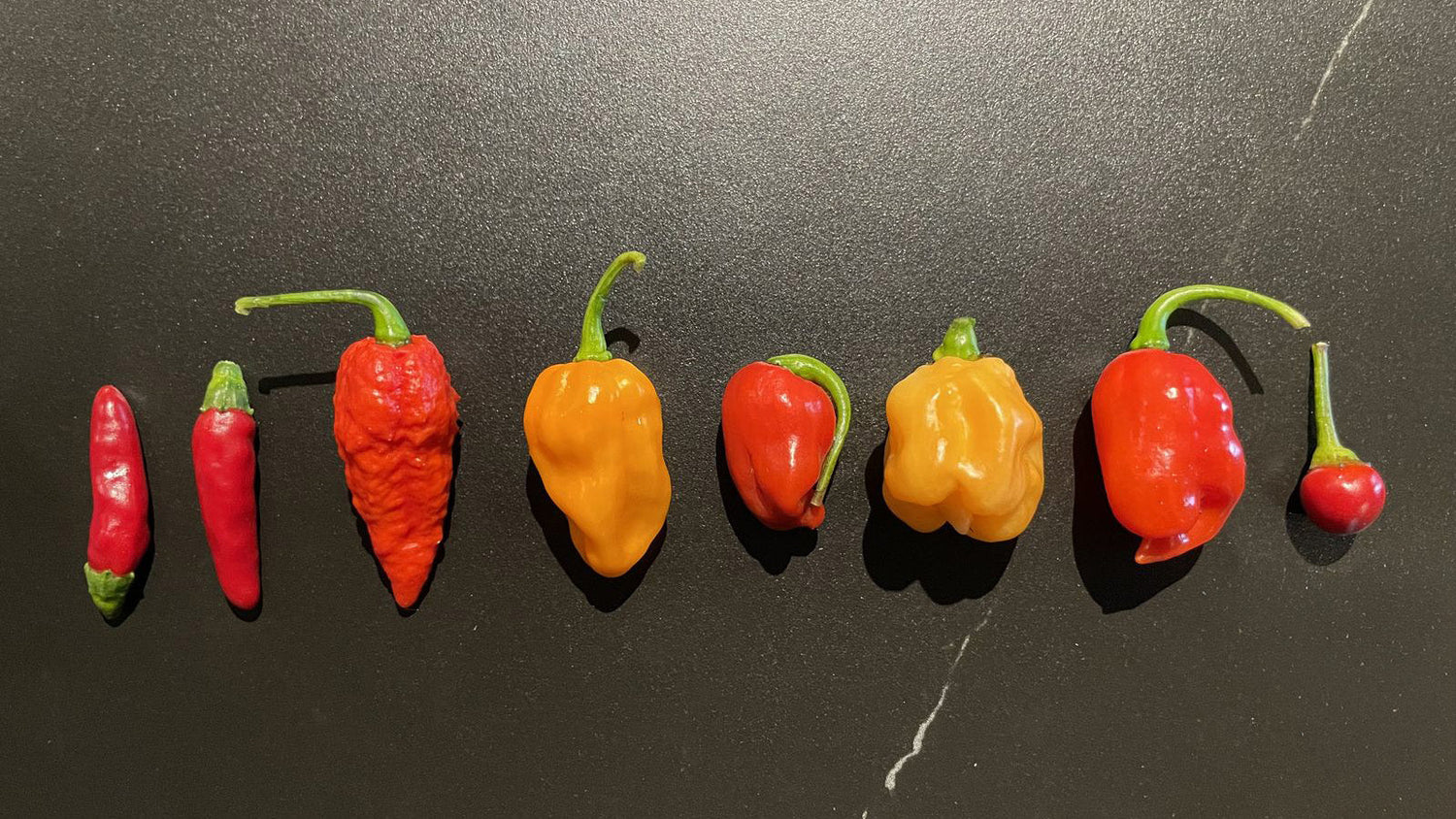
As of 2026, the hottest pepper in the world is Pepper X, with a value of 2,693,000 SHU.
We cultivate approximately 200 different hot pepper varieties in our greenhouse in Beykoz, Istanbul. This journey began in 2023 with an Instagram page and a few pots in the backyard. While Ömer was pursuing his master's degree in new agricultural techniques in London, Doruk was working on hydroponic systems. The question "Which products not available in Turkey can be grown with these methods?" led us to peppers. Both of us had one thing in common: we loved spice.
Today, with grow light systems and controlled climate conditions, we grow peppers year-round. A significant portion of the peppers on this list have been personally cultivated, dried, ground, tasted, and processed into products by us. In this article, while sharing the 10 hottest peppers in the world according to the Scoville scale, we have also indicated which ones we grow in our greenhouse and offer in our products.
Happy reading and spicy journeys!

What is the Scoville Scale?
A brief note before we get to the list: The heat level of peppers is measured in Scoville Heat Units (SHU). This measurement determines the concentration of capsaicin in the pepper. Capsaicin is the molecule that stimulates the pain receptors on your tongue, creating that familiar "burning" sensation. Today, this measurement is done using a laboratory method called HPLC (High-Performance Liquid Chromatography).
Let's make a comparison from everyday life:
- Bell pepper: 0 SHU (no heat)
- Jalapeño: 2,500–8,000 SHU
- Turkish hot pointed pepper: ~10,000 SHU
- Police pepper spray: ~1,600,000 SHU
- Pure capsaicin: 16,000,000 SHU
Now let's get to the list — we'll start with the "mildest" and work our way up to the top. Peppers marked with 🌱 are varieties we grow in our greenhouse and offer in our products.
10. 🌱 Habanero Orange — 100,000–350,000 SHU

Habanero is one of the most recognized names in the hot pepper world. It has been used for centuries in Mexico and the Caribbean. What makes it special is not just its heat; it's the tropical, fruity aroma you feel with the first bite. It has notes of mango, apricot, and citrus — quite a surprising flavor profile for a pepper.
We grow Habanero Orange in our greenhouse and offer it as both Spicy Salt and Chili Flakes. Especially the Habanero version in our Spicy Salt is the easiest way to bring this pepper's tropical aroma to everyday meals. Add a pinch to eggs, grilled chicken, or french fries — you'll immediately taste the difference.
Our tasting note: It might be a bit high for those new to spice, but it's a pepper that rewards with its aroma. Ideal for intermediate to advanced spice lovers.
9. 🌱 Bird's Eye — 50,000–100,000 SHU

An indispensable part of Southeast Asian cuisine, the Bird's Eye is a pepper that belies its small size. You'll find it everywhere from Thai dishes to Indonesian sambals. It has a sharp, piercing, and rapidly rising heat — it hits you instantly.
Our Bird's Eye, offered as Chili Flakes, adds serious heat and a lively character when added in small amounts to soups and sauces.
Our tasting note: One of those peppers that look small but pack a big punch. Great for those who love spice but want to use it controlled.
8. 🌱 Scotch Bonnet — 100,000–350,000 SHU

Habanero's Caribbean cousin, the Scotch Bonnet, got its name because its shape resembles a Scottish bonnet. It's a staple of Caribbean cuisine — jerk chicken wouldn't be jerk chicken without Scotch Bonnet.
Its heat level is similar to Habanero, but its flavor profile is different: sharper, fruitier, and a bit more impactful. The Scotch Bonnet version in our Spicy Salt collection was one of our first products and is still one of the most in-demand.
Our tasting note: If you like Habanero, you should definitely try Scotch Bonnet — they're like two siblings, but with different characters.
7. 🌱 Habalokia Red — Estimated 500,000+ SHU

Habalokia, as its name suggests, is a cross between Habanero and Bhut Jolokia (Ghost Pepper). It combines the fruity aroma of Habanero with the deep, lingering heat of Ghost Pepper. As it's a hybrid variety, there's no official Guinness record, but based on our cultivation experiences, it ranks above 500,000 SHU.
This variety, which we grow in our greenhouse and offer as both Spicy Salt and Chili Flakes, is a gateway for serious spice lovers: if Habanero is no longer enough but you're not yet ready for Ghost Pepper, Habalokia is for you.
Our tasting note: A great example of how interesting results hybrid peppers can yield. It falls "somewhere in between" but has a very strong character of its own.
6. 🌱 Naga Morich Chocolate — 1,000,000–1,500,000 SHU

Naga Morich, hailing from Bangladesh and northeast India, is a close relative of the Ghost Pepper. Its Chocolate version, with its dark brown color, is visually and tastefully different. The "chocolate" in its name doesn't come from cocoa, but interestingly, it genuinely carries light chocolaty, earthy notes.
We have the Naga Morich Chocolate version in our Spicy Salt collection — in the 4x🌶️ "Very Very Hot" category. This salt adds incredible depth to meat dishes and burgers.
Our tasting note: A pepper that crosses the 1 million SHU threshold. Anything beyond this is truly in the "extreme" category. For experienced spice lovers.
5. 🌱 Ghost Pepper (Bhut Jolokia) — 855,000–1,041,000 SHU

Also known as the "Ghost Pepper," Bhut Jolokia is the name that changed the hot pepper world by winning the Guinness World Record in 2007. It has been cultivated for centuries in the Assam and Nagaland regions of northeastern India, and local people reportedly even used it to keep wild elephants away from their fields. Measured between 855,000 and 1,041,000 SHU in HPLC tests at Winthrop University and New Mexico State University, the Ghost Pepper became the first scientifically proven pepper to exceed 1 million SHU.
Ghost Pepper is one of the varieties we grow the most in our greenhouse. We offer it in three different forms: Spicy Salt (blended with rock salt), Chili Flakes (dried and ground), and whole Dried Peppers. Each has different uses.
With the first bite, you get a smoky, earthy aroma. Then, within 5-10 seconds, the heat gradually climbs and stays in your mouth for about 20-30 minutes. Instead of an "instant hit" like Habanero, Ghost Pepper gives more of a "slowly rising wave" sensation.
Our tasting note: The legend of the hot pepper world. Cultivating it, drying it, and turning it into a product is always exciting. For first-timers, our advice: start with the Chili Flakes version and use a very small amount.
4. 7 Pot Douglah — 1,853,986 SHU

The hottest member of the 7 Pot family, whose name means "one pepper makes seven pots of stew hot." Originating from Trinidad and Tobago, this pepper is easily distinguished by its dark brown-burgundy color.
7 Pot Douglah stands out not only for its heat but also for its deep and complex flavor profile. Chocolate, coffee, nutty, and slightly fruity notes all combine — finding such rich aroma in such a hot pepper is truly rare. Among hot pepper enthusiasts, it's known as "the best-tasting super-hot pepper."
Our tasting note: The "darkest" pepper on the list — both in color and taste. Works wonders when used in small amounts to deepen the flavors of sauces and marinades.
3. 🌱 Trinidad Scorpion Butch T — 1,463,700 SHU

Named for its pointed tip resembling a scorpion's tail, the Trinidad Scorpion is a variety that won the Guinness World Record for the hottest pepper in 2011. The Butch T variant is named after its developer, Butch Taylor. Although the record was broken by the Carolina Reaper in 2013, at 1,463,700 SHU, it remains one of the most respected names in the hot pepper world.
We offer this pepper as Dried Peppers — whole, with its full aroma preserved. You can add it whole to soups, stews, or sauces and let it slowly release its aroma and heat by cooking for a long time. Or you can grind it yourself in a mortar to prepare fresh chili flakes.
At one of our events, when our stand was quite crowded, we chopped up a super hot pepper into small pieces and asked, "Would anyone like to try it?" At first, everyone was hesitant. But it only took one person to say, "Let's try it" — and at that moment, we saw once again that there's truly no other equivalent to experiencing this together. People's facial expressions, their glances at each other if they're trying it with friends, speak volumes. Their grimaces, uncontrolled laughter, changing opinions a few seconds after saying, "this wasn't that hot for me…" All are a natural part of this experience.
Our tasting note: A variety we personally grow and offer as Dried Peppers. Its sweet, fruity start is followed by an intense and long-lasting heat that lingers for about 20 minutes.
2. Trinidad Moruga Scorpion — 2,009,231 SHU

Originating from the Moruga region of Trinidad and Tobago, this pepper was declared the world record holder at the time with 2,009,231 SHU in tests conducted by the New Mexico State University Chile Pepper Institute in 2012. It is recognized by its characteristic scorpion-tail shape and wrinkled surface.
It has an interesting feature: with the first bite, you get a sweet, almost sugary taste. Then, within a few seconds, the heat climbs incredibly rapidly and doesn't stop. This "delayed hit" feature is the most distinctive difference that sets Moruga Scorpion apart from other super-hot peppers.
Our tasting note: A variety we haven't regularly grown in our greenhouse yet, but it's in our future plans. Don't be fooled by its deceptive sweet start — this pepper is serious.
1. Pepper X — 2,693,000 SHU 🏆

The reigning champion. Pepper X officially earned the title of the world's hottest pepper, confirmed by Guinness World Records on August 23, 2023. At an average of 2,693,000 SHU, it significantly surpassed the average of the previous record holder, Carolina Reaper (1,641,183 SHU) — and even has a higher value than police pepper spray (~1,600,000 SHU).
Pepper X was developed by American grower Ed Currie, who also created the Carolina Reaper. Currie states that the development of this pepper took approximately 10 years, and his goal was not just heat, but also to achieve a specific flavor profile.
Its greenish-yellow color and relatively smooth surface give a more "innocent" impression compared to the aggressive appearance of the Carolina Reaper — but one should definitely not be fooled by this appearance.
Note: Pepper X is not currently a variety we grow in our greenhouse. Ed Currie continues to control the distribution of Pepper X seeds and production details.
Bonus: Carolina Reaper — Average 1,641,183 SHU (Peak: 2,200,000 SHU)

The reason we're including the Carolina Reaper as a "bonus" is that it reigned as the world's hottest pepper for a full 10 years, from 2013 to 2023. Although dethroned by Pepper X, it remains the most iconic name in hot pepper culture.
It was developed by Ed Currie in South Carolina, by hybridizing a St. Vincent Habanero with a Ghost Pepper. In Winthrop University tests, it measured an average of 1,641,183 SHU, and up to 2,200,000 SHU in individual samples.
Its characteristic curved tail and wrinkled red surface make it visually unforgettable. The taste surprisingly starts fruity and sweet — then an incredible wave of heat comes within a few seconds.
We have grown the Carolina Reaper Yellow variety in our greenhouse. Meeting people like Ed Currie is a big dream for us — we are inspired by people who truly embrace this work and pursue the goal of "producing the hottest pepper."
From Our Greenhouse to Your Table: Which Ones Do We Grow?

The peppers from this list that we grow in our greenhouse and process into products are: Habanero Orange, Bird's Eye, Scotch Bonnet, Habalokia Red, Naga Morich Chocolate, Ghost Pepper (Bhut Jolokia) and Trinidad Scorpion Butch T. In addition to these, we also grow dozens of other varieties not on the list but excellent in their own right, such as Cayenne Pepper, Mulato Pepper, Madame Jeanette, Samandağ Pepper, Gusto Purple, Aji Charapita Red, Jumping Beans.
We offer all these peppers in three different forms:
Spicy Salt: The meeting of unrefined crystal rock salt and pepper extract. You add hot pepper flavor at the same time as you salt your food. Unlike the direct pungency of fresh peppers, this form allows even the hottest peppers to be tasted in a balanced and comfortable way.
Chili Flakes: A single type of pepper in each jar. While chili flakes on the market are usually made from a mixture of various peppers, with us, you get the pure aroma of that specific pepper in every bottle.
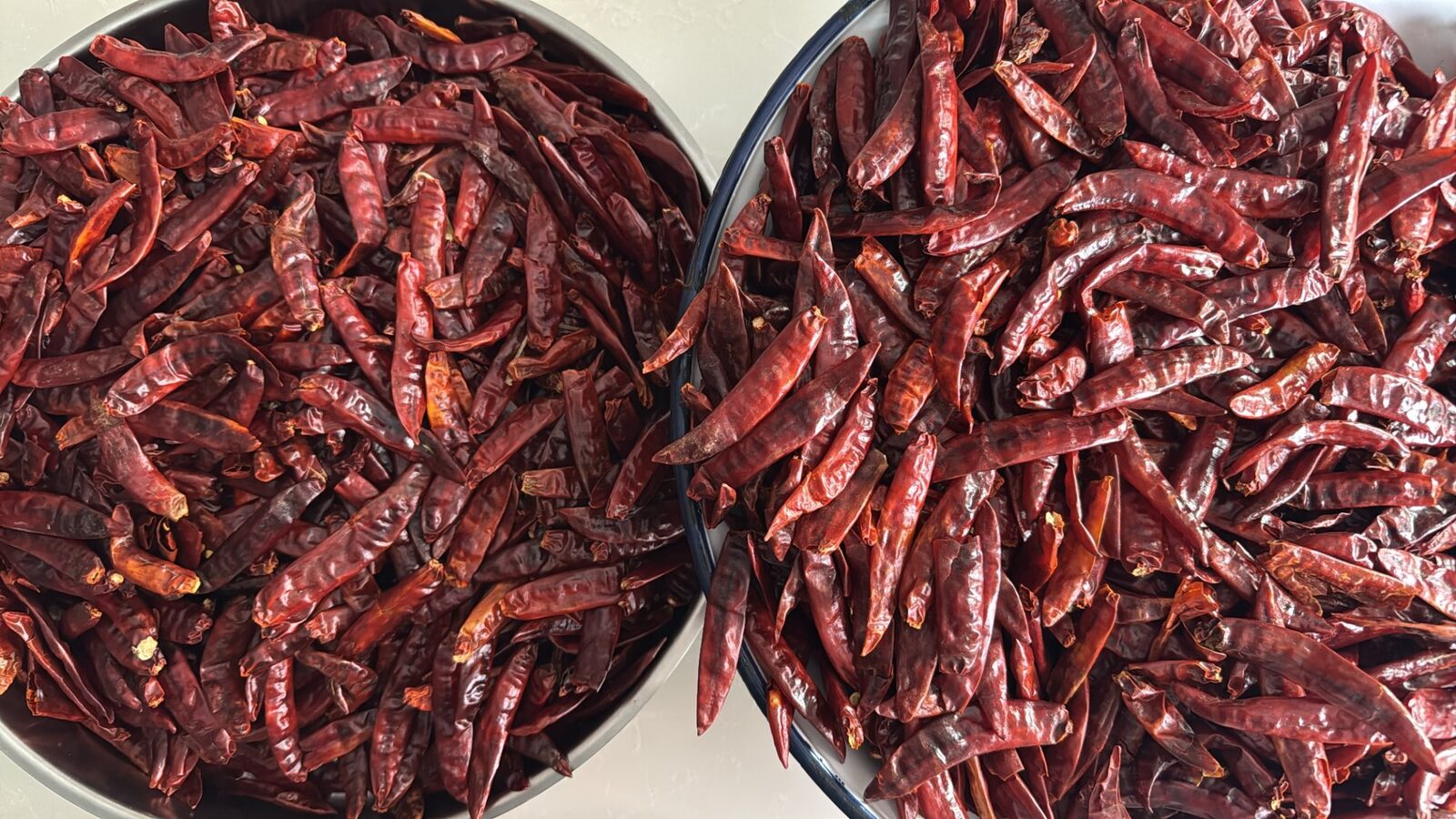
Dried Peppers: Whole dried peppers. Add them to soups, stews, or grind them yourself.
There's no single definition of spice — everyone has a different heat level and experience. Our goal is to introduce even those who don't like spice to it; because there's definitely a level of heat suitable for them. We work with different peppers, from the mildest to the most intense, and continue to let as wide an audience as possible experience them.
Frequently Asked Questions
What is the hottest pepper in the world?
As of 2026, the official world record holder is Pepper X, developed by Ed Currie, with an average value of 2,693,000 SHU. It was confirmed by Guinness World Records on August 23, 2023. The previous record holder, Carolina Reaper, ranks second with an average of 1,641,183 SHU.
Can the hottest pepper be eaten?
Yes, but with extreme caution. We recommend using super hot peppers in very small amounts. We always start with the least spicy and work our way up — offering high heat levels all at once can intimidate people. Excessive consumption of extremely hot peppers can lead to stomach cramps and shortness of breath.
What is the hottest pepper in Turkey?
Traditional Turkish peppers (Antep, Hatay, Urfa, Maraş) are around 10,000 SHU on average.
Turkey's hottest pepper is the Samandağ Pepper, grown in the Samandağ district of Hatay, with a Scoville (SHU) heat value of approximately [value missing]. This pepper, which has a very long and pointed structure, is known for its intense heat and is said to be 3-4 times hotter than Mexican peppers. In our greenhouse in Istanbul, we grow super hot peppers exceeding 1,000,000 SHU, such as Ghost Pepper and Trinidad Scorpion.
What should I do after eating hot pepper?
Don't drink water — water spreads capsaicin around your mouth, making the situation worse. Instead, consume milk or yogurt; the casein protein in milk neutralizes capsaicin. Ayran is also a very good option. Honey can also help.
How is the Scoville scale measured?
Today, the laboratory method called HPLC (High-Performance Liquid Chromatography) is used. This method directly measures the amount of capsaicin in the pepper, providing very reliable results. The original Scoville test in 1912 was done with human tasters, but this method was subjective, so it was replaced by HPLC.
Is hot pepper healthy?
Scientifically, capsaicin is known to speed up metabolism, increase endorphin (happiness hormone) secretion, and contribute to immunity. However, we focus more on the creativity in the kitchen and the different experiences we provide to people, rather than this aspect.
This article was prepared by the çokacıolmuş team, who cultivate more than 200 varieties of hot peppers in their greenhouse in Beykoz, Istanbul. For your questions, you can reach us on Instagram or through our contact page.

Leave a comment
This site is protected by hCaptcha and the hCaptcha Privacy Policy and Terms of Service apply.