
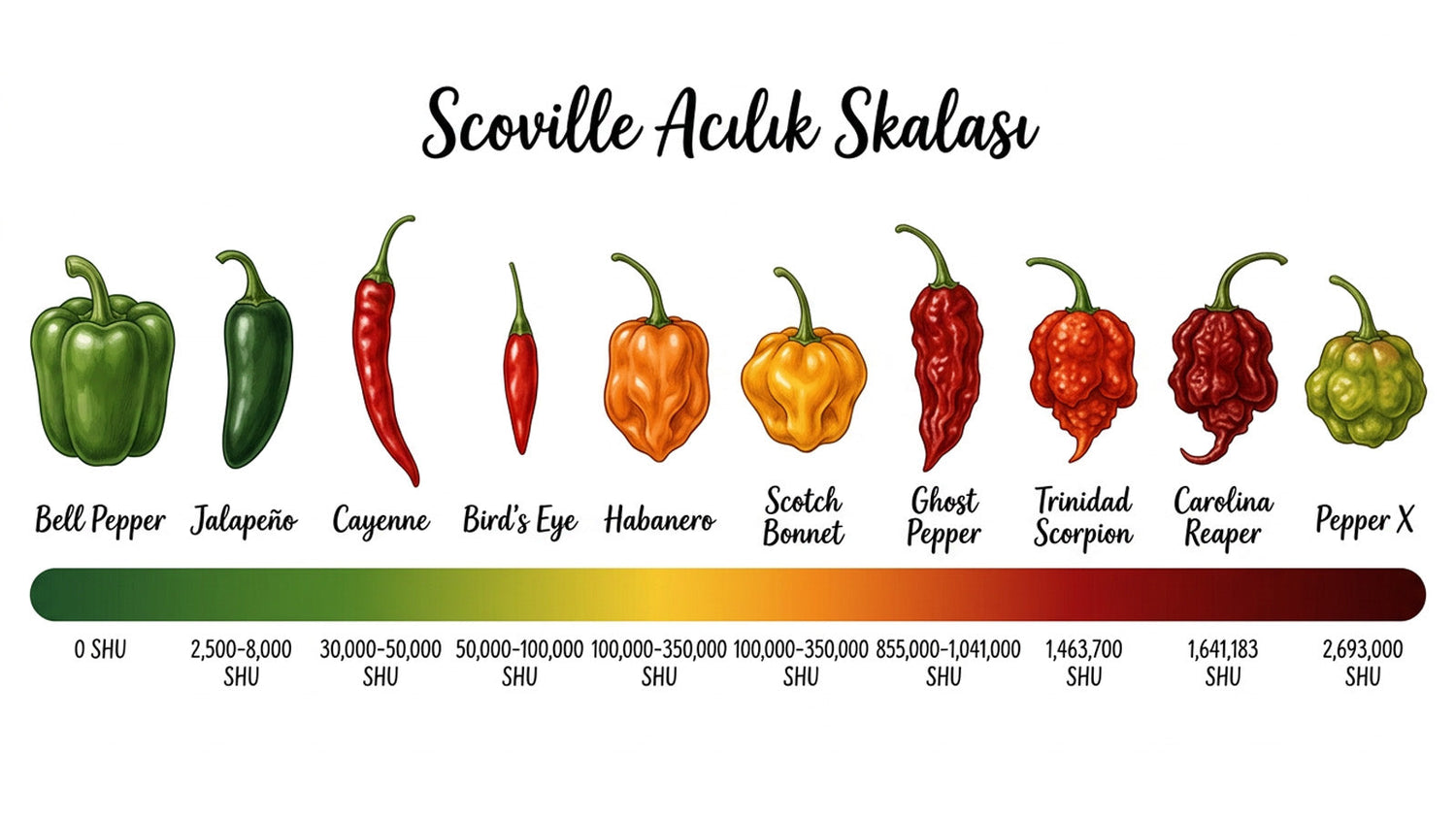
The Scoville scale is the international standard used to measure the pungency level of peppers. Developed in 1912 by American pharmacist Wilbur Scoville, this scale assigns a pungency score (SHU — Scoville Heat Units) to each pepper based on its capsaicin content. Ranging from 0 SHU for a bell pepper to 2,693,000 SHU for Pepper X, this scale is the common language of the hot pepper world.
So, how do we know how hot a pepper is? Why is the same type of pepper sometimes hotter, and sometimes milder? And most importantly: what exactly does the substance we call capsaicin do in our bodies?
With approximately 200 different hot pepper varieties grown in our own greenhouse, we seek answers to these questions. From 30,000 SHU Cayenne to 1,400,000 SHU Trinidad Scorpion. Every day, we work with peppers of varying pungency levels, drying, grinding, and tasting them. In this article, we've examined the Scoville scale from both a scientific and experiential perspective.

How Did the Scoville Scale Come About?
The story begins in 1912 with Wilbur Scoville, a pharmacist working at the Parke-Davis pharmaceutical company in America. Scoville's aim was not actually peppers but medicine — he wanted to standardize the dosage of capsaicin-containing muscle pain creams. For this, he needed a method to measure the pungency level of peppers.
The method he developed was quite simple: He dissolved dried pepper in alcohol, then diluted this solution with sugared water. He had a panel of five tasters try it and continued diluting until no pungency was felt. The amount of dilution required to eliminate the pungency gave the pepper its Scoville value. So, a Jalapeño having 5,000 SHU means that its pepper extract needed to be diluted 5,000 times for its pungency to disappear.
This method — the Scoville Organoleptic Test — was used as the standard from 1912 until the 1980s. But it had a significant weakness: it relied on human taste perception. Everyone's perception of heat is different, and even an individual's sensitivity can change throughout the day. Furthermore, the palate would become fatigued after tasting several samples consecutively. Results could vary by up to 50% between laboratories.
How Is Pungency Measured Today? The HPLC Method
From the 1980s onwards, the scientific world switched to a much more reliable method: HPLC (High-Performance Liquid Chromatography). This method does not rely on human tasters — it directly measures capsaicinoid compounds in peppers in a laboratory setting.
How does HPLC work? To put it simply: a pepper sample is dissolved in a solvent, and then this solution is passed through a chromatography device. The device separates and measures the amounts of compounds like capsaicin and dihydrocapsaicin individually. The measured amount of capsaicin is converted into an SHU value using a mathematical formula.
This method is much more precise, repeatable, and objective. Today, all official pungency measurements, including Guinness World Records, are done with HPLC. But in everyday life, we still say "Scoville" — because the unit remained the same, only the measurement method changed.
Capsaicin: The Molecule That Creates Heat
That familiar burning sensation you feel on your tongue when you bite into a pepper is not actually a taste — it's a pain signal. Capsaicin stimulates TRPV1 receptors in your tongue and mouth. These receptors are normally responsible for sensing heat — so capsaicin tricks your body into thinking "you're burning!"
The body releases endorphins in response to this "false alarm" — the brain's natural painkiller and happiness hormone. This is why you feel a sense of relief and even a slight euphoria after eating something spicy. This is the scientific explanation behind loving hot peppers: your body rewards you for coping with the pain.
What's interesting is that capsaicin doesn't actually cause any tissue damage. It triggers a burning sensation, but no actual burn occurs. This is why regular hot pepper consumers can develop tolerance to higher pungency levels over time — the receptors become desensitized.
Scoville Chart: How Hot Is Each Pepper?
Below we have compiled the Scoville values of the most well-known peppers. The peppers marked with 🌱 are varieties we grow in our greenhouse and offer in our products.

Mild to No Heat (0 – 10,000 SHU)
Bell Pepper: 0 SHU — No heat at all. Our reference point.
Banana Pepper: 0 – 500 SHU — Sweet, mild pepper.
Jalapeño: 2,500 – 8,000 SHU — The world's most well-known hot pepper. Similar to Turkish hot sivri pepper.
Turkish hot sivri pepper: ~10,000 SHU — The everyday pungency level consumed in Turkey.
Medium Heat (10,000 – 100,000 SHU)
Serrano: 10,000 – 23,000 SHU — A bit sharper than a Jalapeño.
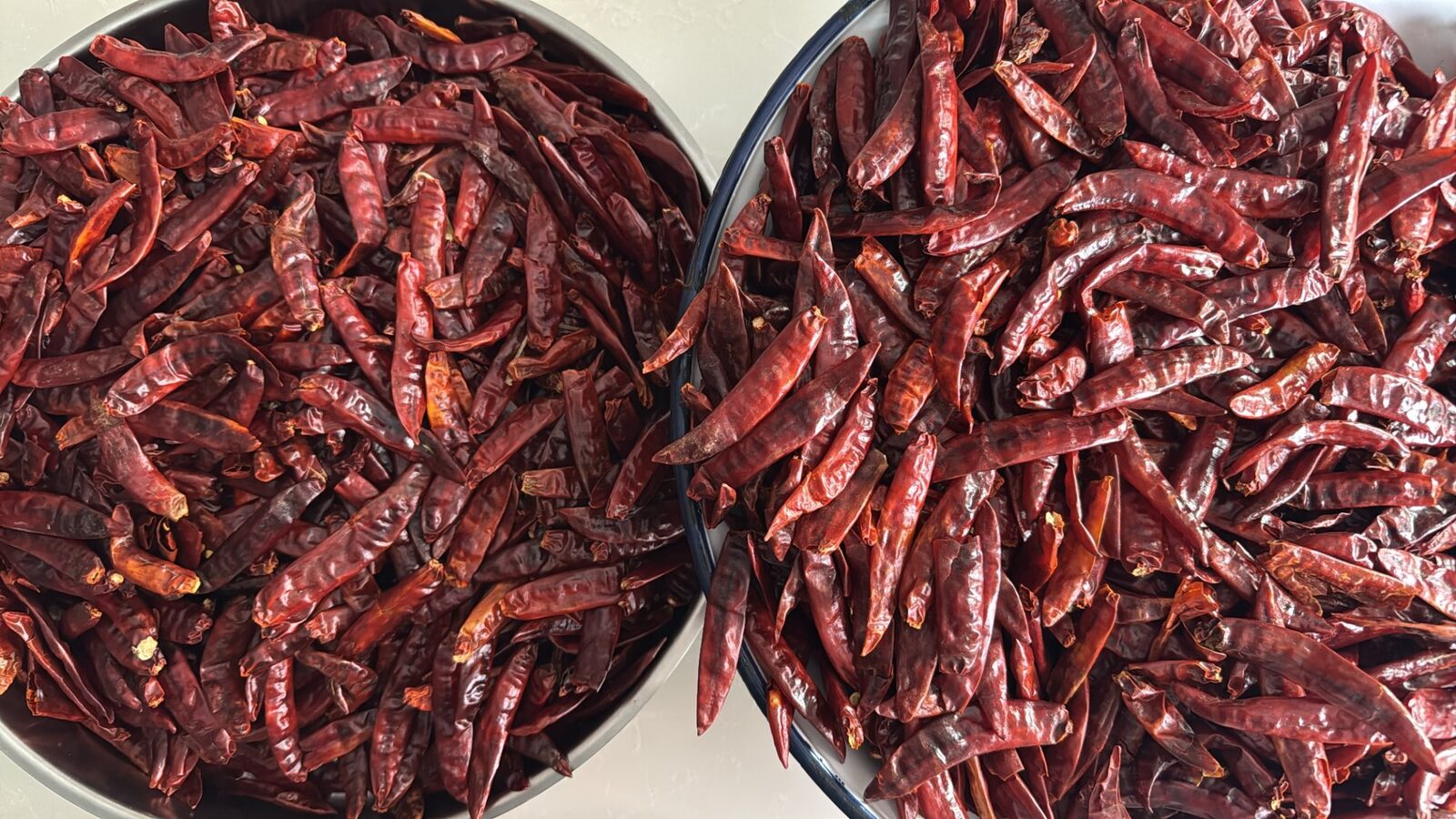
🌱 Cayenne (Arnavut Biberi): 30,000 – 50,000 SHU — Known as "Arnavut Biberi" in Turkey, an ideal balance point for entering the world of hot peppers. We offer it as Chili Flakes and Dried Chili Peppers.
🌱 Bird's Eye: 50,000 – 100,000 SHU — A staple of Southeast Asian cuisine, a pepper not to be underestimated by its small size. Available as Chili Flakes.
High Heat (100,000 – 500,000 SHU)
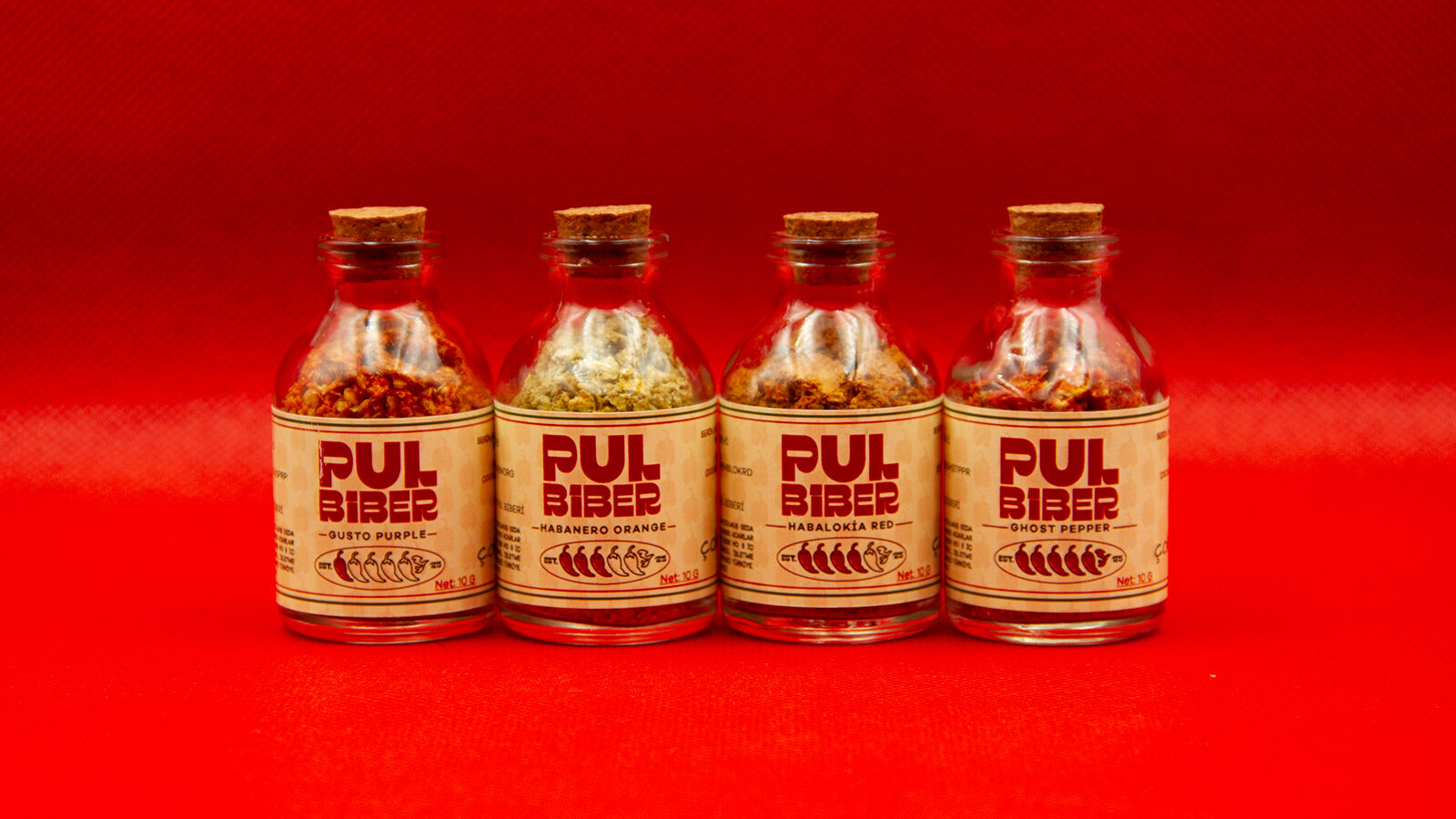
🌱 Habanero Orange: 100,000 – 350,000 SHU — One of the most recognized names in the hot pepper world, with a tropical, fruity aroma. In our Spicy Salt and Chili Flakes collections.
🌱 Scotch Bonnet: 100,000 – 350,000 SHU — Habanero's Caribbean cousin, essential for jerk chicken.
🌱 Habalokia Red: Estimated 500,000+ SHU — A Habanero and Ghost Pepper cross. A transition point for serious chili lovers.
Super Hot (500,000 – 1,000,000 SHU)
🌱 Ghost Pepper (Bhut Jolokia): 855,000 – 1,041,000 SHU — The legendary pepper that held the Guinness World Record in 2007. A slow-building heat that lasts 20-30 minutes. We offer it in three forms: Spicy Salt, Chili Flakes, and Dried Chili Peppers.
🌱 Naga Morich Chocolate: 1,000,000 – 1,500,000 SHU — A pepper with subtle chocolate and earthy notes, exceeding the 1 million SHU mark.
🌱 Trinidad Scorpion Butch T: 1,463,700 SHU — The world record holder of 2011. An intense and long-lasting heat after a sweet start.

Extreme Heat (1,000,000+ SHU)
7 Pot Douglah: 1,853,986 SHU — Known as the "best tasting super-hot pepper" with chocolate, coffee, and nutty notes.
Trinidad Moruga Scorpion: 2,009,231 SHU — Famous for its deceptively sweet beginning, the record holder of 2012.
Carolina Reaper: Average 1,641,183 SHU (Peak: 2,200,000 SHU) — Held the title of the world's hottest pepper for 10 years between 2013-2023.
Pepper X: 2,693,000 SHU 🏆 — The world's hottest pepper since 2023. Even hotter than police pepper spray (~1,600,000 SHU).
Beyond the Pepper
Police pepper spray: ~1,600,000 SHU
Pure capsaicin: 16,000,000 SHU — Theoretical maximum. Not found in nature in this form.
Why Can the Same Pepper Have Different Pungency Levels?
We also constantly encounter this question in our greenhouse. Even two plants grown from the same Ghost Pepper seed can produce peppers with different pungency levels. There are several reasons for this:
Growing conditions: Temperature, sunlight, soil composition, and irrigation amount directly affect capsaicin production. Plants under stress (lack of water, high temperatures) generally produce more capsaicin — because capsaicin is actually a defense mechanism produced by the plant to protect itself against insects and mammals.
Maturity: Fully ripe peppers are usually hotter. Peppers harvested when green have lower SHU values than those harvested when they turn red.
Which part of the pepper: Most of the capsaicin is concentrated not in the seeds, but in the white membrane tissue (placenta) on the inner wall of the pepper. Removing this membrane can reduce the pungency by up to 70%.
Genetic variation: Even different seeds of the same species can produce different levels of capsaicin. This is why scientific measurements usually provide a range — for example, "Habanero: 100,000 – 350,000 SHU."
This situation affects us too. The pungency level of Ghost Peppers we grow in the same season, in the same greenhouse, can vary from batch to batch. This is simply the nature of nature — and it's one of the things that makes the world of hot peppers so interesting.
What to Do After Eating a Hot Pepper?
This is the most frequent question we hear at our events. Someone tries a super-hot pepper, their facial expression changes after a while, and then comes the "what should I do?" look. Here's what you need to know:
Do not drink water. Capsaicin is not water-soluble — water will spread the heat in your mouth, making the situation worse. This is the first mistake everyone makes unknowingly.
Drink milk or yogurt. The casein protein in milk binds to and neutralizes capsaicin. Ayran works the same way. We always keep ayran with us at our events — no joke, it's truly the most effective solution.
Eat fatty foods. Capsaicin is fat-soluble. Olive oil, butter, or peanut butter will alleviate the heat.
Eat bread or rice. Starchy foods absorb capsaicin, reducing its effect.
Try honey. Sugar-based solutions also help balance the heat.
And most importantly: stay calm. Capsaicin doesn't cause actual harm — the effect will pass within 15-30 minutes. Use one of the methods above to shorten this period.
From Our Greenhouse to the Scoville Chart: What Pungency Levels Do We Offer?

We categorize our products by pungency levels so that everyone can find what suits their taste:
🌶️ Mildly Hot (0 – 30,000 SHU): Mulato Chili Flakes — With its mild heat and smoky, chocolatey aroma, it's ideal for beginners and daily use.
🌶️🌶️ Hot (30,000 – 50,000 SHU): Cayenne Chili Flakes — Controllable heat, ideal for those who want to enter the world of hot peppers.
🌶️🌶️🌶️ Very Hot (100,000 – 350,000 SHU): Our Habanero and Scotch Bonnet Spicy Salt and Chili Flakes products. They offer both flavor with fruity aromas and serious heat.
🌶️🌶️🌶️🌶️ Extremely Hot (500,000 – 1,000,000 SHU): In this Category, we offer Naga Morich Chocolate Spicy Salt. For experienced chili lovers.
🌶️🌶️🌶️🌶️🌶️ Super Hot (1,000,000+ SHU): Trinidad Scorpion Butch T Dried Chili Peppers, Special Pepper Blend Chili Flakes and Dried Ghost Pepper Dried Chili Peppers. Only for those who are truly ready.
Our aim is not to force everyone to eat the hottest pepper — but to find a suitable pungency level for everyone. We work with different peppers, from the mildest to the most intense, and continue to let as wide an audience as possible experience them.
Frequently Asked Questions About the Scoville Scale
What does SHU stand for?
SHU is the abbreviation for "Scoville Heat Units." It is the international unit that numerically expresses the pungency level of a pepper. The higher the value, the hotter the pepper.
What is the hottest pepper on the Scoville scale?
As of 2026, the world's hottest pepper is Pepper X with 2,693,000 SHU. It was officially confirmed by Guinness World Records on August 23, 2023. For more detailed information, you can check our article Top 10 Hottest Peppers in the World.
Where do Turkish peppers rank on the Scoville scale?
Traditional Turkish peppers (Antep, Hatay, Urfa, Maraş) are around 10,000 SHU on average. Samandağ Pepper, known as Turkey's hottest pepper, has a value of approximately 50,000 SHU. In our greenhouse in Istanbul, we grow super hot peppers like Ghost Pepper and Trinidad Scorpion, which exceed 1,000,000 SHU.
Is a pepper with a higher Scoville value higher quality?
No. The pungency level is not directly related to quality. Each pepper has its own unique aroma, flavor profile, and use. A 30,000 SHU Cayenne offers a warm and deep aroma rather than pure heat; a 1,000,000 SHU Ghost Pepper has a smoky, earthy character. What matters is not the heat, but the flavor behind that heat.
Is capsaicin harmful?
Capsaicin consumed in normal amounts is not harmful. On the contrary, its metabolism-boosting, pain-relieving, and antioxidant properties are scientifically documented. However, excessive consumption can lead to stomach cramps and digestive problems. We always recommend consuming according to your own tolerance level. For more information, we discussed the health effects of capsaicin in detail in our article What is Cayenne Pepper?
Is it possible to develop tolerance to heat?
Yes. When you regularly and gradually consume increasing amounts of hot peppers, TRPV1 receptors become desensitized over time. We always recommend this to our customers: start with the mildest, observe your body's reaction, and progress slowly. Heat is a marathon, not a sprint.
This article was prepared by the çokacıolmuş team, which grows over 200 varieties of hot peppers in its greenhouse in Beykoz, Istanbul, based on scientific sources and our own production experiences. For more information about the world of hot peppers, check out our articles Top 10 Hottest Peppers in the World and What is Cayenne Pepper? You can reach us on Instagram for your questions.

Leave a comment
This site is protected by hCaptcha and the hCaptcha Privacy Policy and Terms of Service apply.